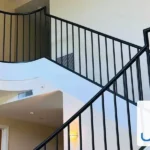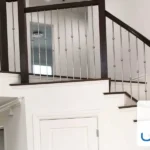

A wrought iron railing is the strongest, longest-lived railing you can put on a porch, balcony, or staircase — and the one that asks the most of you in return. Iron does not rot, warp, or attract insects, and a well-kept railing outlasts the house around it. The trade-off is rust: iron’s only real enemy is moisture reaching bare metal, so the finish is everything. This guide covers the styles, how iron compares to aluminum and steel, the California code rules, what a railing costs, and the care routine that keeps it looking new.
Quick picks: best traditional look — scrollwork balusters with a wood handrail cap. Best modern look — straight vertical bars in matte black powder coat. Best for coastal homes — galvanized iron with a powder-coat finish, or stainless steel instead. Best value over 50 years — a simple, well-finished iron railing with an annual inspection.
What Is a Wrought Iron Railing?
Traditional wrought iron is low-carbon iron with a fibrous grain, shaped hot by a blacksmith’s hammer. It is strong, malleable enough to bend into curves and twists, and it does not flex or wobble when properly installed. One honest point first: true wrought iron is no longer commercially produced. The wrought iron railings sold today are mild steel, forged and finished to look and behave like the original — the same strength, the same look, the same care needs, and the same decades-long life. When a fabricator says “wrought iron” in 2026, mild steel is what they mean, and there is nothing wrong with that: it is the industry standard, and it is what every railing in this guide is made from.
Iron railings go anywhere a guard or handrail is needed: front steps and porches, balconies and decks, interior staircases, and pool areas. They suit almost any architecture — brick and stone homes especially, but also modern homes, where a slim black iron rail pairs with wood treads and glass. Our metal railing service covers iron, steel, and aluminum systems across the Bay Area, fabricated to your measurements rather than bought off the shelf.
Wrought Iron Railing Styles: Traditional Scrollwork vs Modern Lines
Traditional scrollwork. The classic look: C-scrolls and S-scrolls, baskets, single and double twists, knuckles, finials, and medallions — the ornamental vocabulary of Victorian and Art Nouveau ironwork. Scrollwork suits period homes, colonial and Mediterranean architecture, and any staircase that wants to be a focal point. The trade-off is cleaning: every curve and crevice traps dust and moisture, so ornate rails need more attentive care than straight bars (see the care section below).
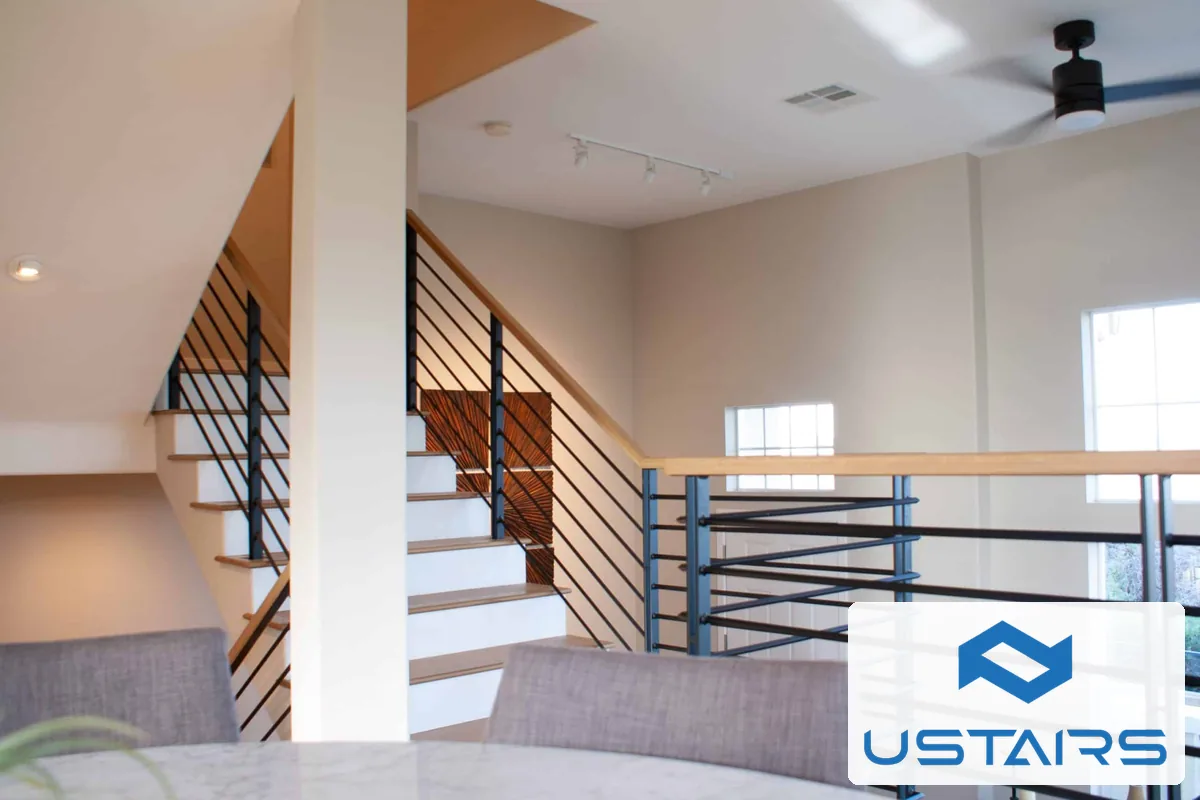
Modern clean lines. Straight vertical bars, horizontal bars, or geometric panels — minimal, slim, and architectural. Modern iron pairs with wood handrails, glass guards, and concrete stairs, and it is the most requested style on contemporary Bay Area homes. Straight bars are also the easiest iron to keep clean and the simplest to touch up, because there are no crevices for moisture to hide in.
Custom motifs. Because iron is forged, not moulded, a fabricator can build almost anything: family crests, geometric patterns, vines and leaves, or a pattern matched to existing ironwork on the house. A custom railing built to your measurements is how a one-of-a-kind design fits a real staircase.
| Feature | Wrought iron | Aluminum | Stainless steel |
|---|---|---|---|
| Strength | Highest — rigid, no flex | Good — lighter, can flex on long runs | Very high — rigid like iron |
| Look | Traditional or modern; ornate scrollwork possible | Clean and modern; limited ornate work | Sleek and modern; minimal ornament |
| Weight | Heavy — needs solid anchoring | Light — suits older porches | Heavy — needs solid anchoring |
| Rust resistance | Needs its finish intact — rusts if bare metal is exposed | Does not rust | Does not rust (316 grade near the coast) |
| Maintenance | Annual inspection + touch-ups; repaint every few years | Wash occasionally; almost none | Wash occasionally; almost none |
| Custom design | Extensive — forged to any pattern | Limited — mostly stock profiles | Moderate — fabricated, not forged |
| Lifespan | 50+ years with maintenance | 30–40 years | 50+ years |
| Relative cost | Higher upfront | Mid-range | Higher upfront |
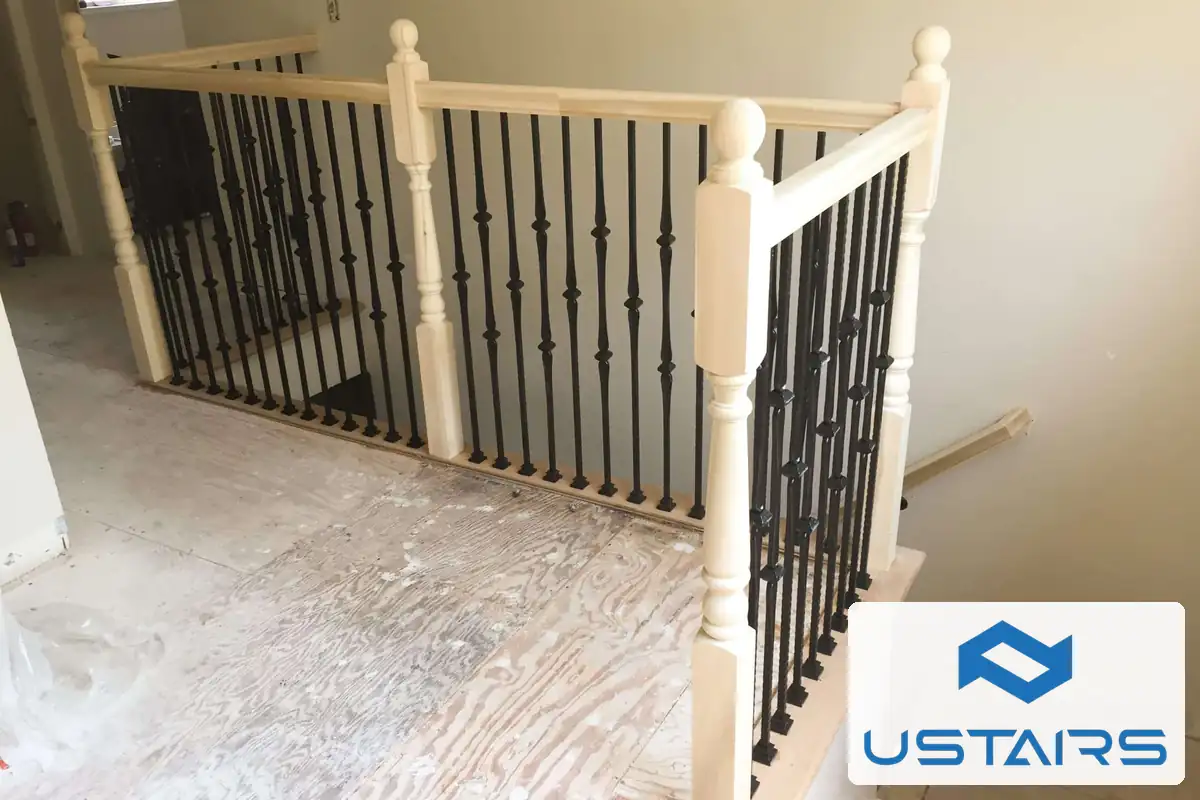
Wrought Iron Stair Railing
A wrought iron stair railing follows the stair’s angle, which is what makes it a fabrication job rather than a kit job: every baluster is a different length, the handrail has to be bent or welded to the slope, and the anchoring has to hold on treads that may be wood, concrete, or stone. On an open staircase the iron guard does double duty — the top rail is often the handrail too, and when it is, California requires it to sit 34 to 38 inches above the nosings and be graspable, exactly like any handrail (see the code section below).
The wrought iron handrail itself is usually a slim iron bar — cool to the touch, slim in the hand, and very durable. Many homeowners pair iron balusters with a wood handrail cap instead: wood is warmer to grip, comes in profiles your hand closes around more easily, and looks right on a traditional stair. Either way, the handrail has to meet the grip-size rules — a flat iron bar wider than your hand can wrap around fails the graspability test, and an inspector will flag it.
Curved and spiral stairs are where iron earns its keep: iron can be bent to a curve that stock wood or aluminum rails cannot follow, and a curved iron rail is fabricated to the stair’s exact geometry. Our guide to curved staircases covers where curved stairs work best — and why their railings are always custom work.

California Code: What Your Iron Railing Must Meet
A railing is a guard, and guards are regulated. California’s rules are in one important way stricter than the national model code most online articles quote — and most of the top-ranking iron railing guides get this wrong.
- When a guard is required. Once a walking surface sits more than 30 inches above the surface below, a guard is required (CRC R312.1). That covers porches, balconies, decks, landings, and the open side of stairs.
- Height. California requires guards to be 42 inches high — higher than the 36-inch figure in the national IRC that most online guides cite. On the open side of a residential staircase the guard may be 34 inches, but for a porch, deck, or balcony the full 42 inches applies with no exception.
- Openings. No opening in a guard may allow a 4-inch sphere to pass through — that is the gap between balusters, and the gap under the bottom rail too. On stair guards the sphere rule is 4⅜ inches, and the triangular opening where the tread, riser, and bottom rail meet may allow a 6-inch sphere.
- Handrail. Where the guard’s top rail doubles as the handrail on a stair, it must sit 34 to 38 inches above the nosings and be graspable: a circular rail 1¼ to 2 inches across, or a non-circular rail with a perimeter of 4 to 6¼ inches.
- Load. The system must resist a 200-pound concentrated load applied at the top rail, plus a 50-pound load on any individual infill component — a baluster, a panel, a scroll.
- Permits. Most Bay Area jurisdictions require a permit and an inspection when a guard is added or replaced. Requirements vary by city and county, so confirm the current rules with your city’s permit office before you order. Our guide to California staircase code covers the full set of rules — guards, handrails, treads, and risers.
How Much Does a Wrought Iron Railing Cost?
There is no fixed price for a wrought iron railing — every railing is measured, fabricated, and installed to one porch, balcony, or staircase, so the price follows the length, the design, and the site. As a guide from our own recent projects, a metal porch railing starts from $1,500 — that is a job minimum, varying by size and finish (powder-coated). For a wrought iron handrail specifically, metal handrails run $1,300 for 4 + brackets, covering fabrication and materials, varying by count, length, and finish.
What moves the number:
| Factor | What it means | Effect on price |
|---|---|---|
| Length and height | Total run length, plus California’s 42-inch guard height | The biggest single cost driver — more iron, more balusters, more labour |
| Design complexity | Scrollwork and custom motifs vs straight bars | Ornate, hand-forged work costs more than simple bars |
| Finish | Paint vs powder coat vs galvanizing | Better protection costs more upfront and less over the railing’s life |
| Posts and anchoring | Surface-mounted vs core-drilled; concrete vs wood vs stone | More anchoring work adds labour |
| Site access | Hillside lots, upper-level balconies, tight stairwells | Difficult access and heavy sections add install time |
| Old railing removal | Taking out and disposing of the existing railing | Adds to the project |
As a relative guide, iron costs more upfront than aluminum or vinyl and less than a full custom staircase — and over 50 years, the absence of replacement makes it the cheaper railing to own. Every project is priced on its own measurements, materials, and site conditions — the exact figure depends on your stairs, your railing type, and your home. Call Ustairs or send the form with your photos and measurements for your exact range — quotes are free.
Caring for Wrought Iron Railings: Rust Prevention, Cleaning & Repainting
Iron’s only real enemy is rust, and rust only starts where moisture and oxygen reach bare metal. The finish — paint, powder coat, or galvanizing — is the only thing standing between the iron and the air, so every part of the care routine comes back to one job: keep the finish intact.
Inspect once a year. Walk the railing and look for chips, scratches, and bubbles in the finish — especially at the base, at joints and welds, and where ornamental pieces meet, because those are the places water collects. A chip the size of a pinhead is where rust starts; catch it now and it is a five-minute touch-up.
Clean with mild soap and water. Wash with a soft brush or cloth and a mild detergent, rinse thoroughly, and dry completely — never leave the railing wet, and never use a pressure washer, which can lift the finish and force water into hollow balusters. Scrollwork needs a brush in the crevices, where dust and moisture hide.
Touch up chips immediately. Sand the chip lightly, wipe it clean, apply a rust-inhibiting primer, then paint to match in thin, even coats. Keep a small amount of matching paint on hand for exactly this — the faster a chip is sealed, the less rust ever gets a start.
Repairing rust that has already started. For surface rust, the method a blacksmith uses is: scrub with a wire brush to remove loose paint and flaking rust, file or sand the rough patches down to bare metal, spray the exposed metal with a phosphoric-acid rust converter (which turns any rust you missed into an inert black crust), wait a day, then prime with an oil-based metal primer and finish with an oil-based metal paint — glossy lasts longer than flat. On intricate scrollwork, spray the crevices a brush cannot reach. For structural rust — pitting, thinning, or a baluster that moves — call a professional: that is a fabrication repair, not a paint job.
Repainting. An outdoor iron railing needs repainting every few years — sooner near the coast, later under a covered porch. Powder coating lasts longer than paint and resists chipping better, but a chipped powder coat usually needs professional re-coating rather than a brush. Galvanizing — dipping the iron in molten zinc — is the most durable protection of all. Never finish iron with latex paint: the water in it can promote corrosion under the film.
Coastal care. Salt air is the hardest environment for iron: salt fog accelerates corrosion, and salt deposits left on the finish keep working even in dry weather. Near the Bay, rinse salt deposits off regularly, inspect more often than once a year, and specify marine-grade finishes — galvanizing under powder coat, or stainless hardware where iron meets another metal. Our guide to glass railings in wet or coastal environments covers which finishes hold up near the water and which do not.
Frequently Asked Questions
How long does a wrought iron railing last?
With regular maintenance, a wrought iron railing lasts 50 years or more — the iron itself outlasts the finish, so periodic re-coating is the main long-term consideration. The lifespan depends on the finish and the exposure: a covered porch rail lasts longer than a fully exposed coastal balcony rail, and a railing that is inspected and touched up annually lasts far longer than one that is left alone.
Does wrought iron rust?
Yes — when the finish fails and moisture reaches bare metal, iron oxidises into rust, and left alone it keeps eating into the metal. The prevention is simple: inspect the finish once a year, touch up any chip immediately, and keep the railing clean and dry. Coastal homes need more frequent care, because salt air accelerates corrosion.
How much does a wrought iron railing cost?
There is no fixed price — every railing is priced on its own measurements. As a guide from our recent projects, a metal porch railing starts from $1,500, varying by size and finish, and metal handrails run $1,300 for 4 + brackets, covering fabrication and materials. The length, the design complexity, the finish, and the site all move the number. Send photos and measurements for a free exact quote.
What is the difference between wrought iron and steel railings?
True wrought iron is no longer commercially produced — modern “wrought iron” railings are mild steel, forged to look and behave like the original, and that is the industry standard. Stainless steel is a different material: it does not rust, needs almost no maintenance, and suits modern designs, but it cannot be forged into the ornate scrollwork that iron is known for, and it costs more upfront. Choose iron for traditional and custom designs, stainless for a modern look with minimal upkeep.
Is “rod iron railing” the same as wrought iron railing?
Yes — “rod iron railing” is a common misspelling of “wrought iron railing”, and people search for it that way. It means the same thing: a railing made from forged iron (in modern work, mild steel), whether that is scrollwork balusters, straight bars, or a full custom design.
Get a Wrought Iron Railing Built for Your Home
The right wrought iron railing is measured to your porch or staircase, forged to a design that suits your home, finished to survive Bay Area weather, and installed to California code. Ustairs designs and installs wrought iron railings across the Bay Area, from scrollwork stair railings in traditional homes to clean black iron rails on modern staircases. Talk to one of the stair railing companies that measures, fabricates, and installs in-house — and get a free quote for a railing that will outlast the house around it.
Sources
- City of Gilroy Building Division — Residential Stairways, Handrails and Guards (California Residential Code Sections R311.7 and R312) — https://www.cityofgilroy.org/DocumentCenter/View/12314/Residential-Stairs-Handrails-and-Guards-Handout?bidId=
- LegalClarity — California Stair Railing Code: Heights and Requirements — https://legalclarity.org/california-stair-railing-code-requirements/
- Permit Sonoma — B-09 Code Requirements for Residential Stairs — https://permitsonoma.org/divisions/engineeringandconstruction/building/technicalbulletins/b-092020coderequirementsforresidentialstairs
- This Old House — How To Protect Ornamental Metalwork — https://www.thisoldhouse.com/fences/a-blacksmith-shows-how-to-protect-ornamental-metalwork
- Metal Expert — FAQ — https://www.metal-expert.com/en/faq/