A metal stair railing is the strongest, most versatile railing you can put on a staircase — and the one with the widest range of looks, from ornate wrought iron scrollwork to slim stainless rods. Metal does not rot, warp, or attract insects, it holds its line on long runs without flexing, and it can be fabricated to any stair: straight, curved, or spiral. The trade-off is that not all metals behave the same — iron rusts if its finish fails, aluminum dents more easily than steel, and the wrong stainless grade near the coast will spot. This guide covers the four metals, the styles, the California code rules, what a railing costs, and how installation works.
Quick picks: best modern look — stainless steel rods with a wood handrail cap. Best traditional look — wrought iron balusters with scrollwork. Best for outdoors — galvanized steel with a powder-coat finish, or 316 stainless near the coast. Best value over 30 years — powder-coated steel with an annual inspection.
Our metal railing service covers steel, aluminum, and iron systems across the Bay Area, fabricated to your measurements rather than bought off the shelf.
What Is a Metal Stair Railing?
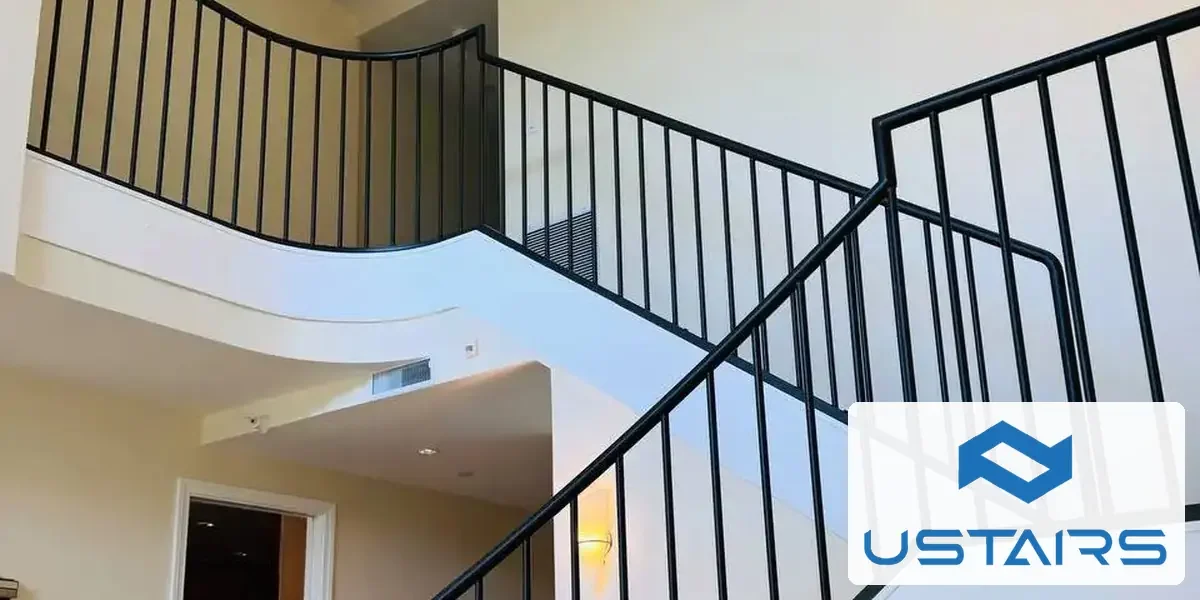
A metal stair railing has three parts, and each one can be a different metal. The posts (or newels) anchor the system to the stair or the floor and carry the load. The handrail — the part you grip — runs along the top; on an open stair it is often the top rail of the guard itself, and it must be graspable, which is why a flat bar wider than your hand can wrap around fails inspection. The infill is what fills the space between the posts and the handrail: vertical pickets, horizontal bars or rods, cables, mesh, or panels.
A metal handrail on its own is different from a full railing: a wall-mounted handrail is just the grip bar on brackets, with no posts or infill, and it suits a closed staircase where the wall is on one side and a guard is not needed. A guard, by contrast, is the full barrier on the open side of a stair — posts, infill, and top rail together — and it is the guard that the code’s height, opening, and load rules apply to.
Metal Stair Railing Types: Steel, Aluminum, Iron & Stainless
Mild Steel & Powder-Coated Steel
Steel is the strongest metal used for stair railings and the most common in custom fabrication. Steel handrails and rails are welded to the stair’s exact geometry, so they suit curved and spiral stairs that stock systems cannot follow. Mild steel must be finished — bare steel rusts — so it is usually galvanized (dipped in molten zinc) and then powder-coated, which is the most durable finish combination. Powder coating comes in any colour, resists chipping better than paint, and lasts years outdoors. The trade-off is weight: steel is heavy, needs solid anchoring, and is not a DIY material — it takes welding equipment and on-site adjustment by a fabricator.
Stainless Steel Stair Railings: 304 vs 316
Stainless steel is the modern look: bright, slim, and almost maintenance-free. It does not rust because a thin chromium layer on the surface regenerates in contact with air and water. Two grades matter. Grade 304 suits indoor stairs and sheltered outdoor spots. Grade 316 contains 2–3% molybdenum, which resists salt — it is the grade to specify near the Bay, on waterfront lots, and anywhere salt air reaches. The trade-off is cost: stainless costs more upfront than mild steel or aluminum, it shows fingerprints on polished finishes (brushed finishes hide them), and it gets hot in direct sun. Stainless steel stair railings pair well with glass panels and wood handrail caps.
Aluminum
Aluminum is the lightest metal railing material and naturally rust-proof — it needs no coating to resist corrosion, though it is usually powder-coated for colour. It suits outdoor steps and decks, coastal homes, and anywhere weight matters (an older porch, a floating stair). The trade-off is strength: aluminum is softer than steel, so it dents and scratches more easily, and wide runs need heavier profiles to avoid flex. It cannot be forged into ornate scrollwork, so the look is clean and modern rather than traditional.
Wrought Iron (Forged Mild Steel)
One honest point first: true wrought iron is no longer commercially produced. The “wrought iron” railings sold today are mild steel, forged and finished to look and behave like the original — the same strength, the same look, the same care needs. Iron is the material for ornate work: C-scrolls, baskets, twists, knuckles, and finials that no other metal can be bent into. It suits period homes, colonial and Mediterranean architecture, and curved stairs. The trade-off is maintenance: iron rusts where the finish fails, so it needs an annual inspection and prompt touch-ups, and repainting every few years outdoors.
| Metal | Finish | Rust resistance | Maintenance | Relative cost | Best for |
|---|---|---|---|---|---|
| Mild steel (galvanized + powder coat) | Galvanize + powder coat, any colour | Good while the finish is intact — rusts if bare metal is exposed | Annual inspection + touch-ups | Mid-range | Custom and curved stairs; most homes |
| Stainless steel 304 | Brushed or polished | Very good indoors; spots in salt air | Wash occasionally | Higher | Modern interiors |
| Stainless steel 316 | Brushed or polished | Excellent — resists salt | Wash occasionally | Highest | Coastal and waterfront |
| Aluminum | Powder coat, any colour | Does not rust | Wash occasionally | Mid-range | Outdoor steps; lightweight builds |
| Wrought iron (forged mild steel) | Paint or powder coat | Rusts if the finish fails | Annual inspection + repaint | Higher | Traditional and ornate designs |
Metal Stair Railing Styles: Pickets, Bars, Rods & Cable
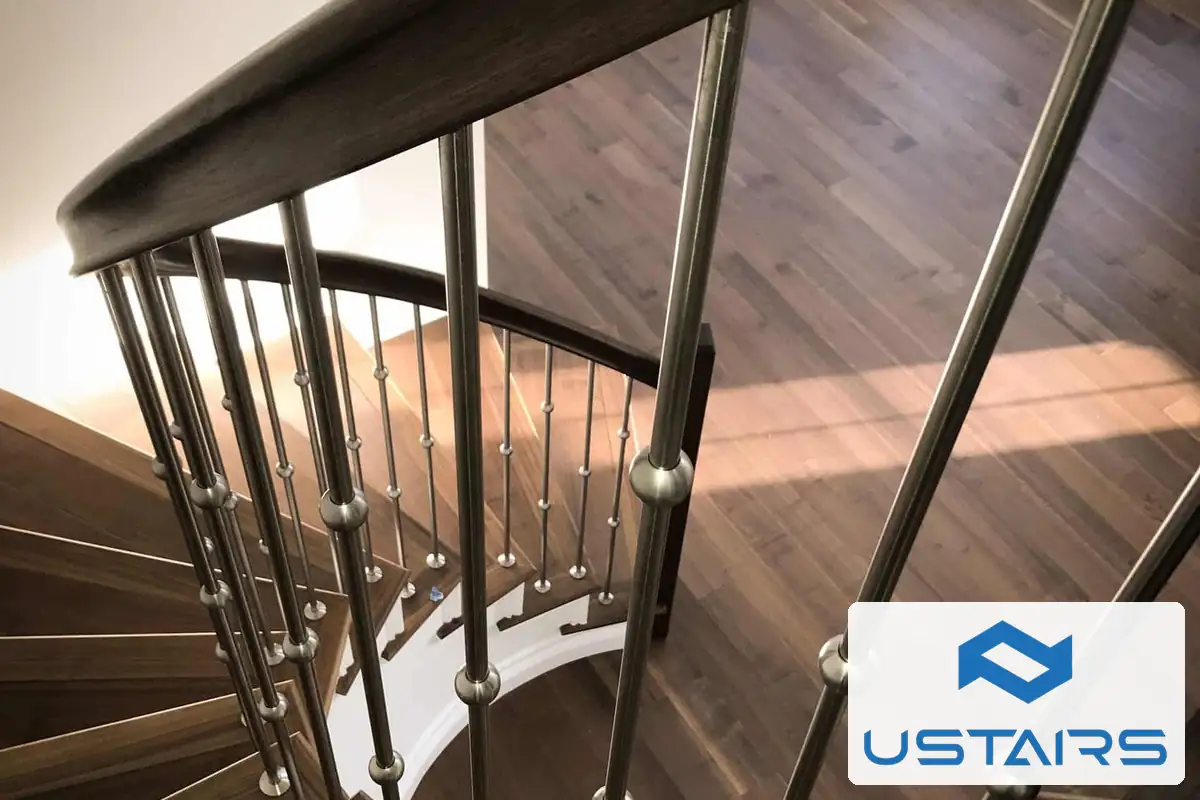
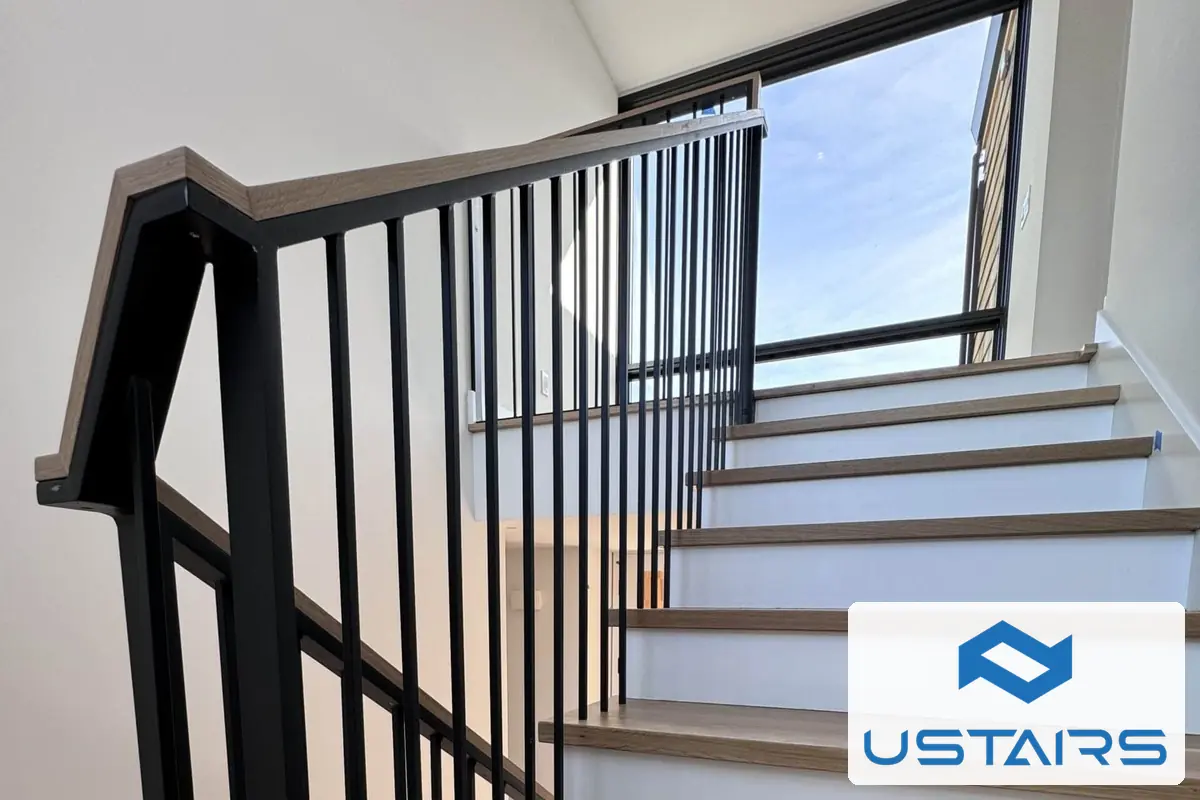
Vertical pickets. The classic: slim vertical bars between the handrail and the stair. Pickets suit any home, are the easiest style to keep code-compliant (the 4-inch sphere rule is simple to meet with vertical bars), and are the lightest option for the posts. The look ranges from plain square bars to turned balusters with collars.
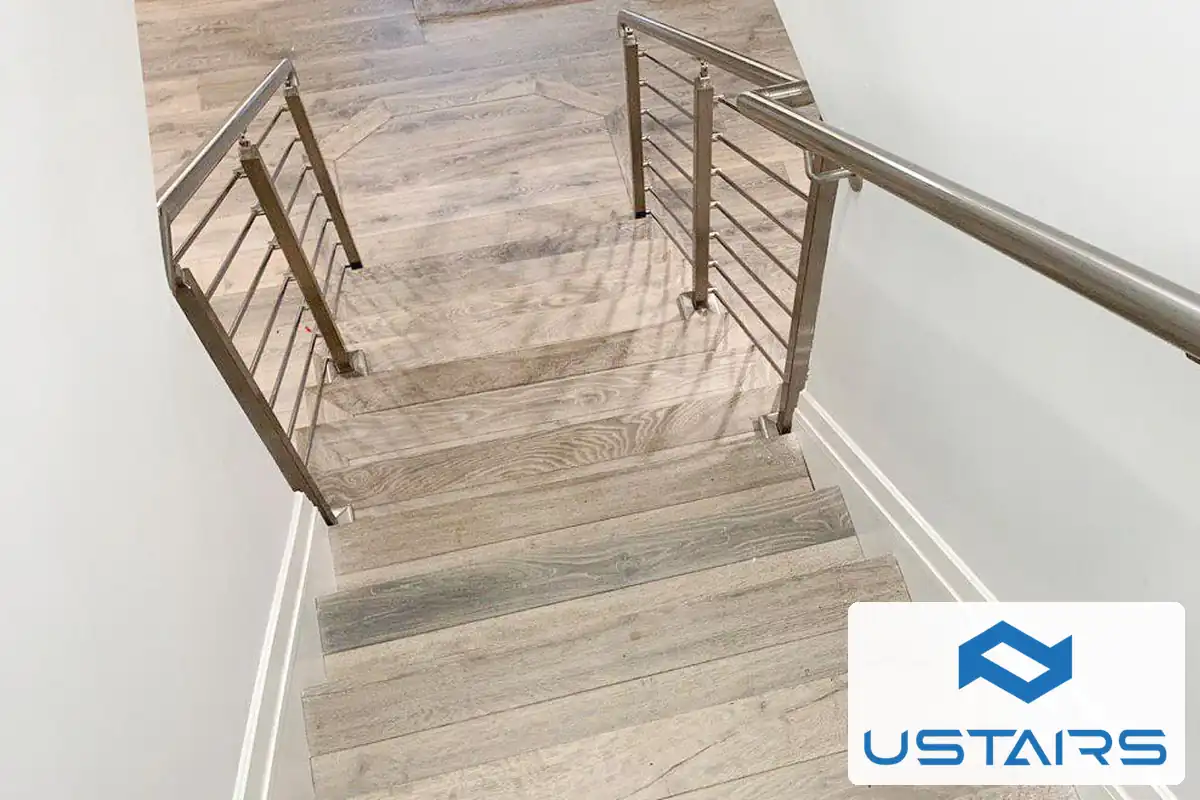
Horizontal bars. Slim horizontal bars or tubes running post to post — the modern look on contemporary Bay Area homes. Horizontal bars open up the sightline and pair naturally with wood treads and glass. One caution: horizontal elements can be climbed, so a few jurisdictions restrict horizontal infill on residential stairs — confirm with your city’s permit office before you commit to the style.
Rod railings. Round metal rods — usually stainless steel — set vertically or horizontally between the posts. Rods are slimmer than pickets, so they disappear into the view while still meeting the sphere rule. Our rod railing systems use stainless rods with a wood or steel handrail cap, and they suit floating stairs and open-plan homes where the railing should not block the light.
Cable. Thin stainless cables tensioned between posts — the most open look of all. Cable needs posts every 3 to 4 feet and careful tensioning, because a cable that deflects under pressure widens the gap: industry practice spaces cables about 3 inches apart so the gap stays under 4 inches when pushed.
Panels and mesh. Perforated metal panels or welded wire mesh set in a frame — the choice for a solid barrier that still lets light and air through. Mesh suits modern homes and commercial stairs; panels suit homes that want privacy without a solid wall.
Indoor vs Outdoor: Choosing for the Location
Metal Railing Indoor
For a metal railing indoor, the finish matters more than the metal: the railing is seen up close every day, so brushed stainless, matte black powder coat, and wood handrail caps are the popular choices. Grade 304 stainless is fine indoors, and mild steel needs only its powder coat — no galvanizing — because it never sees rain. The handrail grip matters most indoors: a slim round steel tube is easy to hold, while a wide flat bar can fail the graspability test. On a floating or open-riser stair, the railing is part of the look — see our guide to open riser stairs for how the stair and the railing work together.
Metal Railing for Steps
A metal railing for steps outdoors faces rain, sun, and — near the Bay — salt air. Galvanized steel under powder coat is the standard outdoor combination; 316 stainless is the premium choice for waterfront lots. Aluminum is the low-maintenance outdoor option because it cannot rust at all. Whatever the metal, the anchoring matters more outdoors: posts must be bolted to concrete or core-drilled into stone, and the base plates need sealing so water does not sit under them. A wall-mounted handrail on exterior steps follows the same grip and height rules as an indoor one — the code does not relax because the stair is outside.
| Metal | Wood | Glass | |
|---|---|---|---|
| Strength | Highest — rigid, no flex | Good — can flex on long runs | High (tempered/laminated) but needs a frame |
| Look | Traditional or modern; widest style range | Warm and traditional | Open and minimal; preserves views |
| Maintenance | Low — wash; touch up iron | Medium — refinish every few years | Medium — fingerprints and water spots show |
| Lifespan | 30–50+ years | 20–30 years | 30+ years (glass); hardware less |
| Relative cost | Mid to higher | Lower to mid | Higher |
| Best for | Most stairs; custom and curved | Traditional homes | Open-plan homes with views |
California Code: What Your Metal Stair Railing Must Meet
A railing is a guard, and guards are regulated. California’s rules are in one important way stricter than the national model code most online articles quote — and several top-ranking guides get this wrong.
- When a guard is required. Once a walking surface sits more than 30 inches above the surface below, a guard is required (CRC R312.1). That covers the open side of stairs, landings, balconies, and decks.
- Height. California requires guards to be 42 inches high — higher than the 36-inch figure in the national IRC that most online guides cite. On the open side of a residential staircase the guard may be 34 inches, but for a landing, deck, or balcony the full 42 inches applies with no exception.
- Openings. No opening in a guard may allow a 4-inch sphere to pass through — that is the gap between balusters, and the gap under the bottom rail too. On stair guards the sphere rule is 4⅜ inches, and the triangular opening where the tread, riser, and bottom rail meet may allow a 6-inch sphere.
- Handrail. Where the guard’s top rail doubles as the handrail on a stair, it must sit 34 to 38 inches above the nosings and be graspable: a circular rail 1¼ to 2 inches across, or a non-circular rail with a perimeter of 4 to 6¼ inches. Handrails must be continuous for the full flight and return to the wall, guard, or a newel post.
- Load. The system must resist a 200-pound concentrated load applied at the top rail, plus a 50-pound load on any individual infill component — a baluster, a rod, a panel.
- Permits. Most Bay Area jurisdictions require a permit and an inspection when a guard is added or replaced. Requirements vary by city and county, so confirm the current rules with your city’s permit office before you order. Our guide to California staircase code covers the full set of rules — guards, handrails, treads, and risers.
Installation: How a Metal Stair Railing Is Built & Fitted
A metal stair railing is a fabrication job, not a kit job — every railing is measured, cut, welded, and finished to one staircase. The process:
1. Measure. The fabricator measures the stair’s rise, run, and angle, and checks the anchoring — wood treads, concrete, or stone each need a different fixing. On a floating stair the posts anchor to the stringer itself, which is why the stringer and the railing are designed together — see our guide to mono stringer vs double stringer stairs for how the two work as one system.
2. Fabricate. The posts, handrail, and infill are cut and welded in the shop to the stair’s exact geometry. Curved stairs are bent or welded to the curve; straight stairs are simpler but still measured to the millimetre, because a handrail that is a fraction off will not sit level.
3. Finish. The railing is galvanized (for outdoor use), powder-coated, or painted — in the shop, before installation, so the finish is even and fully cured.
4. Install. The posts are bolted or core-drilled into place, the handrail is fitted and levelled, and the infill is set to the code spacing. The installer checks the heights, the grip, and the sphere rule before the inspector arrives.
DIY or pro? A wall-mounted handrail on a straight stair is a reasonable DIY job for a confident homeowner — brackets, a level, and a stud finder. A full guard railing is not: it needs welding, code-checked spacing, and anchoring that holds a 200-pound load. A railing that looks finished but fails the load test is worse than no railing at all, because people lean on it with confidence.
How Much Does a Metal Stair Railing Cost?
There is no fixed price for a metal stair railing — every railing is measured, fabricated, and installed to one staircase, so the price follows the length, the metal, the design, and the site. As a guide from our own recent projects, a metal porch railing starts from $1,500 — that is a job minimum, varying by size and finish (powder-coated). For a metal handrail specifically, metal handrails run $1,300 for 4 + brackets, covering fabrication and materials, varying by count, length, and finish.
What moves the number: the length and height of the run; the metal (stainless costs more than mild steel or aluminum); the design complexity (scrollwork and custom motifs cost more than straight bars); the finish (powder coat vs galvanizing under powder coat); the anchoring (surface-mounted vs core-drilled, concrete vs wood vs stone); site access (hillside lots and tight stairwells add install time); and removal of an old railing. Every project is priced on its own measurements, materials, and site conditions — the exact figure depends on your stairs, your railing type, and your home. Call Ustairs or send the form with your photos and measurements for your exact range — quotes are free.
Caring for a Metal Stair Railing
Metal asks less of you than wood, but it still asks something — and the routine depends on the metal.
Steel and iron. Inspect once a year for chips, scratches, and bubbles in the finish — especially at the base, at joints and welds, and where ornamental pieces meet, because those are the places water collects. Touch up any chip immediately: sand lightly, prime with a rust-inhibiting primer, and paint to match. Never leave a chip open — rust starts at bare metal and spreads under the finish.
Stainless steel. Wash with a damp cloth and mild detergent, rinse, and dry — drying matters, because water spots come from limescale left behind. Outdoors, clean every few months; near the coast, monthly. Never use chloride cleaners or steel wool, which can stain the surface.
Aluminum. Wash occasionally with mild soap and water. Aluminum cannot rust, so the routine is mostly cosmetic — but check the fixings once a year, because aluminum’s lightness means a loose screw shows sooner.
Coastal care. Salt air is the hardest environment for any metal: salt fog accelerates corrosion, and salt deposits left on the finish keep working even in dry weather. Near the Bay, rinse salt deposits off regularly, inspect more often than once a year, and specify 316 stainless or galvanized steel under powder coat.
Frequently Asked Questions
What is the best metal for a stair railing?
It depends on the stair and the location. Stainless steel is the best all-round choice for a modern interior — strong, slim, and almost maintenance-free. Powder-coated mild steel is the best value for a custom or curved stair, because it can be welded to any shape. Aluminum is the best choice outdoors where weight matters or rust is a concern. Wrought iron (forged mild steel) is the best choice for a traditional or ornate look. Near the coast, 316 stainless or galvanized steel under powder coat are the only metals that hold up without constant care.
How much does a metal stair railing cost?
There is no fixed price — every railing is priced on its own measurements. As a guide from our recent projects, a metal porch railing starts from $1,500, varying by size and finish, and metal handrails run $1,300 for 4 + brackets, covering fabrication and materials. The length, the metal, the design complexity, the finish, and the site all move the number. Send photos and measurements for a free exact quote.
Is a metal stair railing better than wood?
For strength and lifespan, yes — metal is more rigid, lasts longer, and needs less maintenance than wood. For warmth and grip, wood has the edge: a wood handrail cap is warmer to hold than a steel tube, which is why many homeowners pair metal balusters with a wood handrail. The most popular combination on Bay Area stairs is exactly that — metal below, wood on top.
Does a metal stair railing rust?
Mild steel and wrought iron rust where the finish fails and moisture reaches bare metal — that is why the finish is everything, and why a chip should be touched up immediately. Stainless steel (304 and 316) and aluminum do not rust: stainless has a chromium layer that regenerates, and aluminum forms its own protective oxide. Near the coast, specify 316 stainless — 304 can spot in salt air.
Do I need a permit to replace a stair railing in California?
Most Bay Area jurisdictions require a permit and an inspection when a guard is added or replaced, because the railing is a safety device with code-checked heights, openings, and loads. Requirements vary by city and county — confirm the current rules with your city’s permit office before you order. A railing that fails inspection has to be rebuilt, which is the most expensive kind of railing.
Get a Metal Stair Railing Built for Your Home
The right metal stair railing is measured to your staircase, fabricated to a design that suits your home, finished to survive Bay Area weather, and installed to California code. Ustairs designs and installs metal stair railings across the Bay Area, from stainless rod railings on floating stairs to wrought iron scrollwork on traditional staircases. Talk to one of the stairs railing contractor specialists that measures, fabricates, and installs in-house — and get a free quote for a railing that will outlast the house around it.
Sources
- City of Gilroy Building Division — Residential Stairways, Handrails and Guards (California Residential Code Sections R311.7 and R312) — https://www.cityofgilroy.org/DocumentCenter/View/12314/Residential-Stairs-Handrails-and-Guards-Handout?bidId=
- LegalClarity — California Stair Railing Code: Heights and Requirements — https://legalclarity.org/california-stair-railing-code-requirements/
- Permit Sonoma — B-09 Code Requirements for Residential Stairs — https://permitsonoma.org/divisions/engineeringandconstruction/building/technicalbulletins/b-092020coderequirementsforresidentialstairs
- Deck Expressions — 8 Staircase Railings (Guardrail), Handrails, & Materials — https://www.deckexpressions.com/blog/8-staircase-railingsguardrail-handrails-materials/
- Metal Expert — FAQ — https://www.metal-expert.com/en/faq/