
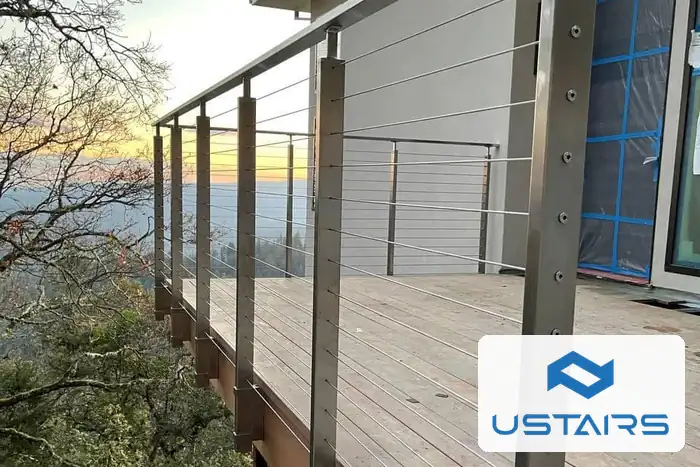
The best cable railing system for decks is a horizontal 316 stainless steel cable system with 1/8-inch cables spaced 3 inches apart, rigid posts no more than 3 to 4 feet apart, and a 42-inch guard height — the California requirement. That combination gives you the most open view of any railing type, passes inspection when it is tensioned and spaced correctly, and holds up for decades with almost no maintenance. The right system for your deck depends on three things: how much view you want to keep, how close you are to salt air, and whether your deck frame can carry the tension — because every cable pulls with more than 300 pounds of force, and the frame matters more than the cable brand.
Quick picks: best view — horizontal black cable with no bottom rail. Best for homes with small children, or in jurisdictions that restrict horizontal infill — vertical cable. Best near the coast — 316L stainless cable and fittings throughout, with no 304-grade hardware anywhere in the system.
What Is a Cable Railing System for Decks?
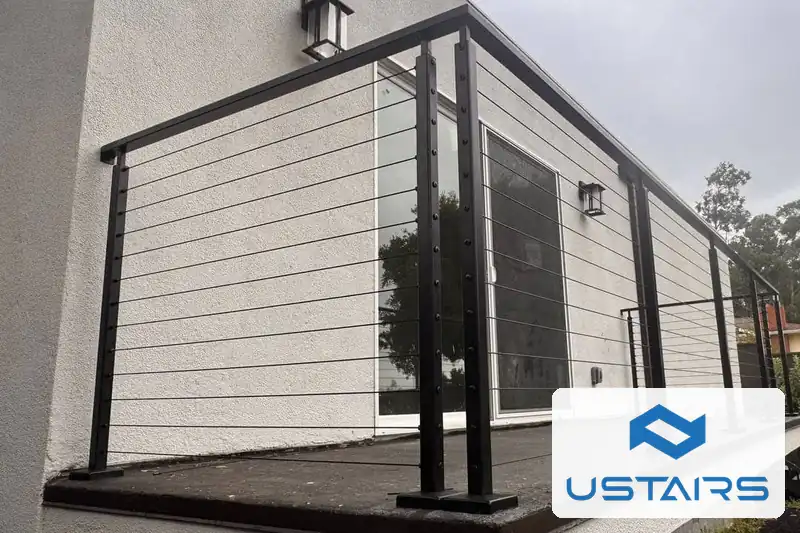
A cable railing system for decks is a guard built from horizontal or vertical stainless steel cables stretched taut between posts, instead of pickets, balusters, or glass panels. The cables are the infill: they close the open edge of the deck so nobody can fall through, and because each cable is only 1/8 or 3/16 of an inch thick, the view stays almost entirely open. A cable railing system for decks has five parts: posts (steel, aluminium, or wood), a top rail, the cables themselves, fittings that anchor each cable to the posts, and tensioners that pull every cable taut.
Tension is what makes the system work — and what makes the frame the most important part. Each properly tensioned cable pulls on its end posts with a load in excess of 300 pounds, so a 42-inch guard with 13 cable runs puts thousands of pounds of pull into the frame. That is why cable railing is an engineered assembly, not a decoration: the posts, the blocking under the top rail, and the connection to the deck framing all have to be sized for the tension, or the posts pull out of plumb and the cables go slack. A kit bought online assumes your frame is already strong enough; a fabricated system is measured and built to your deck’s actual framing.
Cable size is the first choice after the frame. 1/8-inch cable is the residential standard — the lightest visual footprint and more than strong enough for a home deck when properly tensioned. 3/16-inch cable suits commercial projects and high-traffic decks where the extra stiffness matters, at the cost of a slightly more visible line. 1/4-inch cable is for metal frames only and rarely appears on a residential deck.
Horizontal vs Vertical Cable Railing for Decks
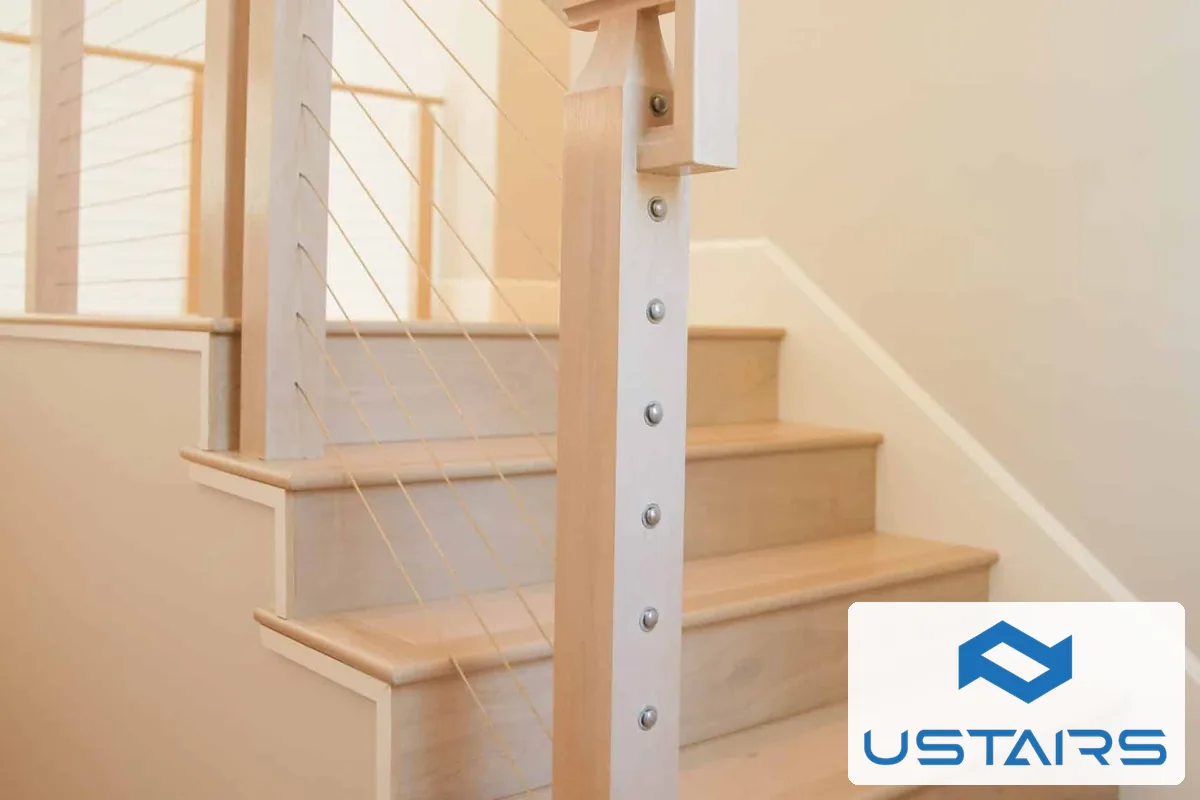
A horizontal cable railing for decks runs the cables side to side between posts, parallel to the horizon — the look most people picture when they think of cable railing. A vertical cable railing for decks runs the cables top to bottom, from the top rail down to a bottom rail, reading like a very slim modern picket railing. Both are code-compliant when they are spaced and tensioned correctly; the choice is about view, code, and installation.
| Feature | Horizontal cable | Vertical cable |
|---|---|---|
| View | Best — lines parallel the horizon and disappear at a distance | Good — thin vertical lines, but they read as a fence up close |
| Climbability | Horizontal runs can read as a ladder; some jurisdictions restrict horizontal infill | No climbability question — reads as pickets |
| Installation | Harder — each cable is tensioned individually, in sequence | Easier — cables often come pre-installed between the rails as panels |
| Cleaning | Wipe down; cables collect dust on top | Wipe down; vertical cables shed dust more easily |
| Post spacing | Posts or vertical spacers every 3 ft to limit deflection | Top and bottom rails carry the cables; posts up to 4–6 ft apart |
| Best for | View-first decks, waterfront and hillside homes | Homes with small children, strict jurisdictions, DIY installs |
Horizontal is the right call on most Bay Area decks, because the view is usually the reason for choosing cable in the first place. Vertical is the right call when a building department pushes back on horizontal infill, when small children will use the deck daily, or when you want the simplest possible installation — vertical cable panels arrive with the cables already fitted between the rails, so the job is mostly setting posts and hanging panels.
The Parts That Decide Quality
Cable grade. The grade of stainless steel in the cable and fittings is the single most important quality decision, and it is the one most buyers never ask about. 316 and 316L stainless steel contain 2–3% molybdenum, which resists the pitting and crevice corrosion that salt air causes; 304 stainless steel has no molybdenum and can start showing rust staining in under a year near the coast. If your deck is anywhere in the Bay Area — not just on the waterfront, because salt travels miles inland — specify 316 or 316L cable and fittings throughout, and make sure the fittings match the cable grade, because a system is only as corrosion-resistant as its weakest fitting. The same salt-air rules apply to every railing material: our guide to glass railings in wet or coastal environments explains which finishes hold up near the water and which do not.
Fittings. Swageless fittings clamp onto the cable without a crimping tool and can be adjusted after installation, which makes them the better choice for most residential projects — re-tensioning a swageless fitting is a ten-minute job. Swaged fittings are crimped onto the cable with a special tool and are permanent, which suits a fabricator’s shop more than a homeowner’s deck. Push-connect fittings thread the cable into a fitting head that locks without tools. Whichever type you choose, every fitting should be the same 316 grade as the cable.
Posts. Steel posts are the strongest and slimmest, and the best choice when the frame has to carry full cable tension on a long run. Aluminium posts are lighter and come powder-coated in a wide range of colours, which suits most residential decks. Wood posts work, but they need to be bigger — a 4×4 minimum at ends and corners — and softer woods may need larger sections still, especially at 42-inch height. Posts can be surface-mounted on top of the deck or fascia-mounted to the outside face of the deck framing; fascia mounting saves floor space on a narrow deck and keeps the mounting hardware out of the sightline.
Black Cable Railing for Decks
A black cable railing for decks pairs black powder-coated posts and rails with black-coated cables, and it is the most requested finish in the Bay Area for a reason: black cable disappears against a dark background, a tree line, or an evening sky in a way silver stainless steel never does, and black posts read as a crisp frame rather than a visual interruption. Look for an AAMA 2605 powder coat — the industry’s highest rating — because a black finish shows every scratch and chip, and a cheap coating will not survive a decade of sun and salt. Black cable also pairs naturally with black window frames, dark composite decking, and modern steel staircases.
Top rail. The top rail is the part you touch, so it should be comfortable to grip and sized to the load: wood for warmth, stainless steel for a clean modern line, or a flat drink rail wide enough to set a glass on. On a deck guard the top rail is the guard cap; on the stairs down from the deck it must also work as a handrail, which means a graspable profile 1¼ to 2 inches across — a flat 2×6 cap will not pass inspection as a handrail.
Cable Railing vs Glass vs Metal Picket: Which Fits Your Deck?
Cable is not the only way to keep a view open. If you are still deciding between railing types, this is how the three modern options compare on a deck:
| Cable railing | Glass deck railing | Metal picket railing | |
|---|---|---|---|
| View | Nearly open — thin horizontal lines | Fully open (frameless) or segmented by posts | Sliced into vertical strips |
| Wind | Lets wind through | Blocks wind — a windscreen | Lets wind through |
| Privacy | None | Frosted/tinted options available | None |
| Cleaning | Occasional wipe-down | Regular — spots and prints show | Occasional wipe-down |
| Child safety | Gaps must stay under 4 in even when a cable is pushed | Solid barrier, no gaps | Gaps must stay under 4 in |
| Relative cost | Mid-range | Highest | Lowest |
Cable wins when you want the view with the least cleaning and a lower price than glass. Glass wins when the deck needs a windbreak or the view must be completely uninterrupted — see our guide to choosing a glass deck railing for how the systems compare in detail. A glass railing also suits decks where small children play, because a solid panel has no gaps at all. Metal picket wins on budget and on decks where the view is not the point. All three must meet the same California guard rules in the next section.
California Code: What Your Cable Railing Must Meet
A railing is a guard, and guards are regulated. California’s rules are in one important way stricter than the national model code most online articles quote — and most of the top-ranking cable railing guides get this wrong.
- When a guard is required. Once a walking surface sits more than 30 inches above the surface below, a guard is required (CRC R312.1).
- Height. California requires guards to be 42 inches high — higher than the 36-inch figure in the national IRC that most online guides cite. On the open side of a residential staircase the guard may be 34 inches, but for a deck the full 42 inches applies with no exception. A 42-inch guard needs 13 cable runs (no bottom rail) against 11 at 36 inches, which is one reason California cable jobs cost more than the national guides suggest.
- Openings — the deflection problem. No opening in a guard may allow a 4-inch sphere to pass through. Cable is the hard case for this rule, because cable flexes: two cables drilled 4 inches apart open wider than that the moment someone leans on them in the middle of a bay. The industry answer is to space cables no more than 3 inches apart and to place posts or vertical spacers at least every 3 feet, so the gap stays under 4 inches even when a cable is pushed. An inspector checks this with a ball, not a tape measure — and some building departments ask for the manufacturer’s specifications or an engineer’s letter confirming the system passes the deflection test.
- Load. The top rail must resist a 200-pound concentrated load applied outward and downward, plus a 50-pound load on any individual infill component.
- Climbable infill. Some California jurisdictions restrict horizontal infill on the grounds that it can be climbed. Most Bay Area cities accept horizontal cable, but confirm with your city’s permit office before you order — if your jurisdiction pushes back, vertical cable is the answer.
- Permits. Most Bay Area jurisdictions require a permit and an inspection when a guard is added or replaced. Expect the building department to ask for the cable specification, the spacing detail, and the anchor detail. For the full picture, see our guide to the California staircase code.
Cable Railing for Decks Cost
Cable railing for decks cost depends on the size of the job more than on any single component, and there is no fixed price for a custom-fabricated railing — every deck is measured and priced on its own. What moves the number:
- Length and height. A longer run needs more cable, more fittings, and more posts, and a 42-inch California guard needs more cable runs than a 36-inch guard.
- Cable grade and size. 316L stainless costs more than 304, and 3/16-inch cable costs more than 1/8-inch — but the grade is the wrong place to save money, because replacing corroded hardware costs far more than specifying the right grade once.
- Post material and finish. Steel posts cost more than aluminium, and a premium powder coat costs more than a standard finish.
- Corners and angles. Every corner needs either a double post or a termination, and angled runs need swivel fittings — a straight run is always the simplest job.
- Site access and deck condition. An upper-level deck with no clear path for long posts adds labour, and an older deck may need framing work or blocking before the anchors go in.
- Permits and inspection fees, which vary across Bay Area counties.
As a relative guide, a cable railing typically costs less than a frameless glass system for the same run and more than a basic metal picket railing — the mid-range option that keeps the view. Every project is priced on its own measurements, materials, and site conditions — the exact figure depends on your deck, your railing type, and your home. Call Ustairs or send the form with your photos and measurements for your exact range — quotes are free.
Installation and Maintenance
A cable railing kit can be a DIY project for an experienced homeowner, but the two hard parts are the frame and the tensioning. The frame has to carry more than 300 pounds of pull per cable, so posts must be bolted to the joists or the deck surface — not just screwed to the decking — and blocking goes under the top rail between posts so they do not pull out of plumb when the cables are tensioned. Tensioning follows a sequence, starting at the centre cable and alternating outward, so the posts load evenly instead of bowing to one side. Given the safety stakes and permit inspections, most Bay Area homeowners hire a specialist, and a fabricated system built to your deck’s exact measurements is the surest way to pass inspection the first time.
Maintenance is straightforward. Rinse with a hose, wash with mild dish soap and a soft cloth, and rinse again — no painting, staining, or sealing. Cables stretch slightly in the first season, so expect one re-tensioning a few months after installation, then an annual check of the tension and the fittings. In coastal Bay Area neighbourhoods, rinse salt spray off regularly — the manufacturer’s guidance is quarterly cleaning within a mile of salt or brackish water. Inspect the fittings at least once a season: look for loose tensioners, frayed cable ends, and any tea staining on the stainless, which is an early sign that a fitting is not the grade it was sold as.
Frequently Asked Questions
How much does a cable railing system for decks cost?
There is no fixed price — every cable railing is priced on its own measurements. The length of the run, the 42-inch California guard height, the cable grade (316L costs more than 304), the post material, the number of corners, and site access all move the number. As a relative guide, cable typically costs less than a frameless glass system and more than a basic metal picket railing. Send photos and measurements for a free exact quote.
How far apart should cable railing cables be?
No more than 3 inches apart, centre to centre, with posts or vertical spacers at least every 3 feet. The code rule is that no opening may pass a 4-inch sphere, but cable flexes under pressure, so the 3-inch spacing leaves a margin that keeps the gap under 4 inches even when a cable is pushed. An inspector checks this with a ball, not a tape measure.
Is horizontal or vertical cable railing better?
Horizontal is better for the view — the lines run parallel to the horizon and nearly disappear. Vertical is better when a building department restricts horizontal infill, when small children use the deck daily, or when you want the simplest installation, since vertical cable often arrives pre-installed between the rails as panels. Both are code-compliant when spaced and tensioned correctly.
Does cable railing meet California building code?
Yes, when properly specified and installed. California requires guards at least 42 inches high on decks more than 30 inches above grade — stricter than the 36-inch national figure most guides quote — with openings no wider than 4 inches, which means 3-inch cable spacing and posts every 3 feet. Most Bay Area jurisdictions require a permit and an inspection, and some restrict horizontal infill, so confirm the current rules with your city’s permit office before ordering.
How do you maintain a cable railing?
Rinse with a hose, wash with mild dish soap and a soft cloth, and rinse again. Expect one re-tensioning a few months after installation as the cables settle, then check tension and fittings once a year. Within a mile of salt or brackish water, clean quarterly. There is no painting, staining, or sealing — that is one of the main reasons homeowners choose cable over wood.
Get a Cable Railing Built for Your Deck
The best cable railing system for decks is measured to your deck, built from 316 stainless steel that suits your exposure, and installed to California code. Ustairs designs and installs cable railing systems across the Bay Area, from horizontal black cable on hillside decks to vertical cable on family decks. Talk to one of the stair railing companies that measures, fabricates, and installs in-house — and get a free quote for a railing that keeps your view and passes inspection the first time.
Sources
- City of Gilroy Building Division — Residential Stairways, Handrails and Guards, based on California Residential Code Sections R311.7 and R312. https://www.cityofgilroy.org/DocumentCenter/View/12314/Residential-Stairs-Handrails-and-Guards-Handout?bidId=
- LegalClarity — California Stair Railing Code: Heights and Requirements. https://legalclarity.org/california-stair-railing-code-requirements/
- Feeney Inc. — Building a Strong Frame: Metal (CableRail frame guide). https://feeneyinc.com/wp-content/uploads/2023/12/F_Frame_Tips_CableRail_Metal_1223-web.pdf
- Permit Sonoma — B-09 Code Requirements for Residential Stairs. https://permitsonoma.org/divisions/engineeringandconstruction/building/technicalbulletins/b-092020coderequirementsforresidentialstairs
- Atlantis Rail Systems — Why Marine Grade Hardware Matters for Deck Railings. https://www.atlantisrail.com/blog/why-marine-grade-hardware-matters-for-deck-railings/